

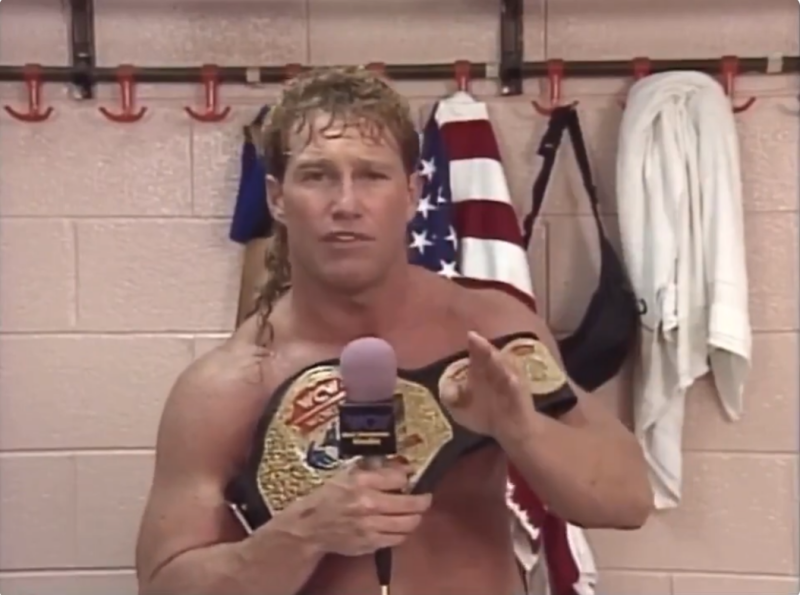
Brad Armstrong was probably as great a technician as there ever was in World Championship Wrestling.
In between the ropes, he moved so fluid and absolutely could make himself and anyone else look as phenomenal as possible. What he lacked in character, he made up with his wrestling prowess.
And it wasn’t like WCW management and creative teams didn’t try. In this writer’s opinion, the gimmicks that they provided him weren’t the best.
In 1990, Brad was the Candyman, a man who gave candy to the fans. That was it. Although he became ⅓ of the WCW Six-Man Tag Team Champions in 1991 as Fantasia, the masked feathered mascot of the Fabulous Freebirds, it was short-lived. And, to complete the trifecta, by the end of the year, he became Arachniaman, a complete Spider-Man rip-off. So much so, Marvel actually sued WCW for it.
To his testament, Brad did his best with everything given to him. He worked hard, but it only got him so far.
However, by the Summer of 1992, Armstrong actually made World Championship Wrestling history.
He was the final WCW Light Heavyweight Champion.
—--
The WCW Light Heavyweight Championship was five years ahead of its time.
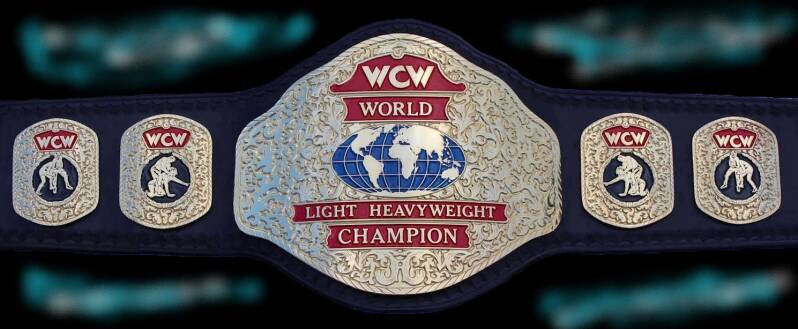
The championship was created in the fall of 1991. After a two month, eight-man tournament, the legendary “Flyin’” Brian Pillman defeated the York Foundation’s Richard Morton (Ricky Morton, but under the corporation of Alexandria York) in the tournament final at Halloween Havoc on October 27, 1991 in Chattanooga, TN to become the first champion.
Two months later, one of WCW’s most underrated and legendary wrestling rivalries began. Jushin “Thunder” Liger, the greatest junior heavyweight in Japan history, defeated Pillman on Christmas Night in the Omni in Atlanta, GA to win the title.
Following a two-month reign, including a successful defense against Norio Honaga in New Japan on February 8, 1992, which also gained him the IWGP Junior Heavyweight Championship for the fifth time, Liger prepared himself to face Pillman in a rematch at SuperBrawl II on February 29, 1992.
To many hardcore wrestling fans, this battle was one of the greatest wrestling matches of all-time. “Flyin’” Brian and Liger put on an absolute classic, going hold-for-hold, and flying with reckless abandon.
At the end of the day, Liger went to the air one too many times, and missed a flying headbutt. Pillman, with a little gas left in the tank, used a modified O’Connor Roll and bridged back for the three count. The crowd exploded with jubilance as “Flyin’” Brian regained his Light Heavyweight Championship.
With Pillman as the crown jewel of the division, it looked as if 1992 was going to be a banner year for junior heavyweights. WCW, in a state of transition, finally had itself a unique identity.
And then, “the Cowboy” came in and shook the entire promotion up.
—--
In May 1992, Bill Watts came into World Championship Wrestling as its new Executive Vice President, replacing Kip Frey. “The Cowboy” was the architect of Mid-South Wrestling, which later turned into the Universal Wrestling Federation in the mid-1980s. His domineering, bordering on abrasive, leadership and knack for quality weekly television built his polarising reputation. You either loved him or hated him, there was no in-between.
With the sole goal of slashing the budget and boosting lagging ratings, Watts went right to work.
Mick Foley in his legendary autobiography Have a Nice Day: A Tale of Blood and Sweatsocks about Mr. Watts’ rules for WCW.
Here are his “Ten Commandments”:
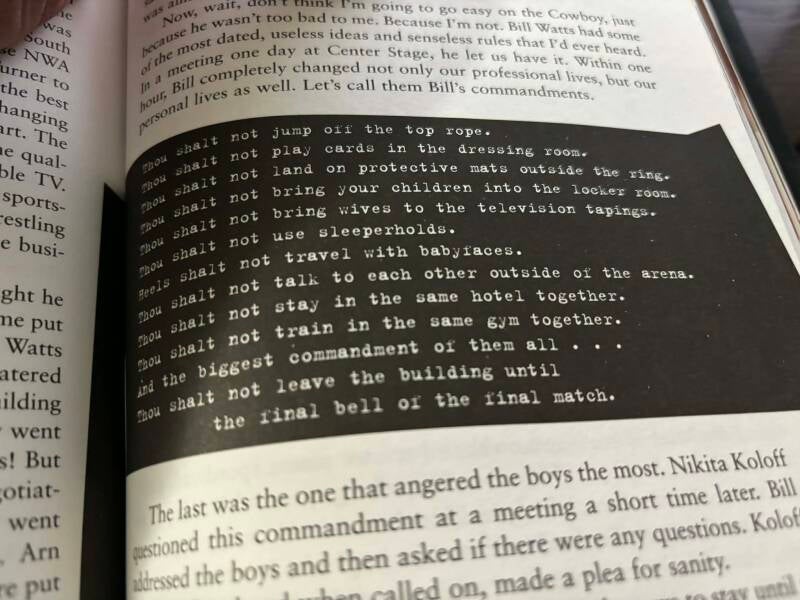
#1 was the most interesting. No jumping off the top rope was a surprisingly antiquated idea, especially for 1992, when high-flying wasn’t the norm as it was today.
It also completely limited the light heavyweight division.
Especially after the incredible Liger/Pillman match at SuperBrawl II, the style that made the championship standout became neutered. Of course, “the Cowboy” proclaimed in later years that the top rope non-usage was going to be a storyline, but it never came back under his reign.
And we got to witness it in all its glory.
In a stunning upset at Beach Blast 1992, Scotty Flamingo, the future Raven, picked up a huge victory over “Flyin’” Brian on June 20, 1992 in Mobile, Alabama. Although the match was solid, the lack of high flying that was to be expected was neutralized.
A few weeks later, we really got to see what Watts wanted out of his light heavyweight division. Good, solid wrestling was on his menu.
The man to serve it was Brad Armstrong.
—--
Coming off his second tour of Japan in 1992 at the beginning of June, Armstrong was ready to unleash.
Prior to this, he was in the thick of the division in the Spring, putting on great performances in losing efforts to Pillman, Flamingo, and the Great Muta.
In fact, the 2-out-of-3 falls match on the May 30th Saturday Night between Brad and Muta is a piece of wrestling beauty. Although Muta won out 2-0, the fighting ability of Armstrong was unbelievable. An absolutely brilliant gem from this time.
Following a win over Pat Rose on Saturday Night on the 4th of July, it was announced, with the champ Flamingo on commentary, that Brad Armstrong would be facing Scotty Flamingo for the Light Heavyweight Championship the next night at the Omni in Atlanta.
Bill Watts’ goal was to make the Omni the Madison Square Garden for WCW, similar to what he did for the Superdome in New Orleans for Mid-South Wrestling. Sadly, it didn’t ultimately build that way, especially since the Omni shows weren’t on television, but at least it led to this cool moment.
On July 5, 1992, Brad Armstrong shocked the world and, with help from his patented Russian Leg Sweep, won the WCW Light Heavyweight Championship!
The next night at the Saturday Night tapings in Center Stage, in his first championship defense, Armstrong went to a ten-minute draw with Jushin “Thunder” Liger. Then, during the Great American Bash Tour on the 9th, 10th, and 11th, Armstrong and Liger wrestled three more times. They went to a draw at the Norfolk Scope in Norfolk, VA, Armstrong got the victory at the Dorton Arena in Raleigh, NC (his only winning championship defense), and another draw at the Diamond in Richmond, VA.
The next day, Brad left for a tour in New Japan Pro Wrestling. He started off great, picking up wins over the great Koji Kanemoto and Black Cat, but on July 23, in a six-man tag team match, alongside the “Beast From The East” Bam Bam Bigelow and the monster Scott Norton, against Riki Choshu, Masa Saito, and the Great Muta, Armstrong blew out his knee.
For the next five weeks, Armstrong flew back home to the United States, trained hard, and did everything he could to make it to the Clash of the Champions XX event on September 2, 1992. However, due to not being medically cleared, the Cowboy had no choice but to begrudgingly strip him of the WCW Light Heavyweight Championship.
Here is the LAST appearance of the #WCW Light Heavyweight Championship.
— The Big Bang May 6 (@TheBigBangMay6) April 18, 2026
Due to an injury suffered on a New Japan tour in July 1992, Cowboy Bill Watts (interviewed by @tonyschiavone24) begrudgingly stripped Brad Armstrong of the gold.
It was never seen again. #TheBigBangMay6 pic.twitter.com/h3f1fZRrgQ
A few weeks later, Brad began his journey back in the ring, actually getting into a solid rivalry with a now villainous Pillman, but the goal was clear: getting back the Light Heavyweight Title.
On the September 26, 1992 episode of Saturday Night, the Cowboy expanded upon his goal of doing a Light Heavyweight Title tournament for the first part of 1993, and ironically enough, eliminating the off-the-top rule, breaking one of his commandments!
Sadly, that tournament never took place. The WCW Light Heavyweight Championship was quietly pushed to the wayside and not thought of again until 1996 and the revolutionary Cruiserweight division was born.
The Light Heavyweight Title walked so the Cruiserweight Championship could run! It really was ahead of its time.
—---
Going back into my old tapes, it’s very telling. Brad Armstrong’s style was tailor-made for what Bill Watts wanted in the Light Heavyweight Championship.
It’s also telling that Brad was never truly pushed as strong ever again once the “Cowboy” left WCW in February 1993. He was always around and could have a great match whenever he was allowed to, but he was never as prominently featured again.
He did have a few more gimmicks - as B.A. in the No Limit Soldiers in 1999 and as Buzz Kill in the “Powers That Be” era, but that’s another story for another day.
As time begins to fade, memories of the “good hands” and solid old-school technicians are forgotten with time. I really was a fan of Brad Armstrong. His brother Brian might’ve been one of the best talkers of all time, his father Bullet Bob might’ve been more legitimately tough, and his other brothers Scott and Steve might’ve been the most underrated tag team in Smoky Mountain Wrestling history, but the best wrestler, to me, was Brad. And that Russian Legsweep was a thing of beauty.
He might not have been first, but he was the last. Brad Armstrong was the final WCW Light Heavyweight Champion, and that’s a Hell of a stat to have.
Bankie Bruce
Add comment
Comments